AirFryHub

Air Fryer Turkey Legs — Time & Temperature

Quick Answer

Standard turkey leg (1–1.5 lb / 450–680 g)

Air fry turkey legs at 375 degrees Fahrenheit for 35 to 45 minutes.

Sear skin side down first; flip at 20 min. Verify 165°F near the bone.

Internal temp: 165°F. Reach 165°F before removal. Includes all poultry, such as chicken, turkey and duck; do not rely on carryover heat.
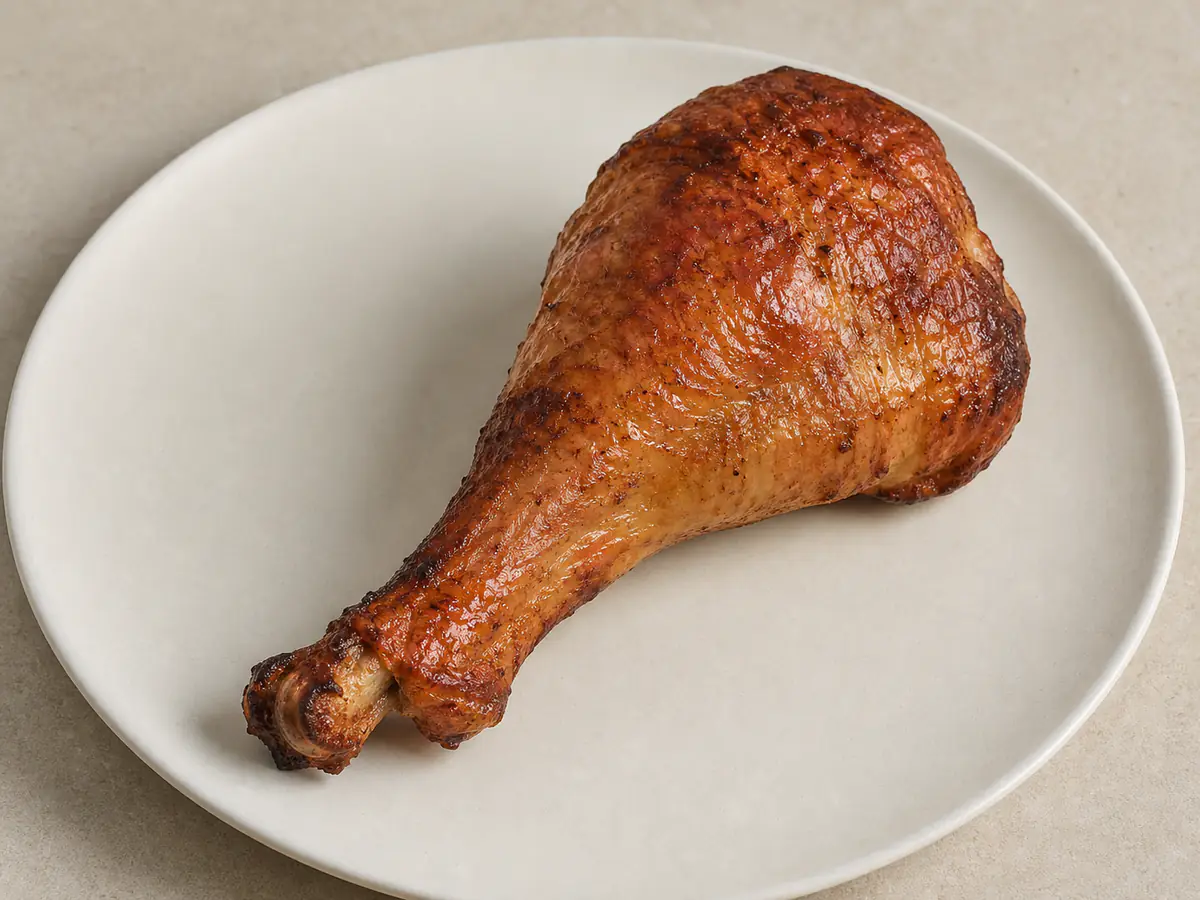
Air-fried Turkey Legs with a naturally browned surface.
Illustrative serving result. Browning and texture vary by food size, basket load, and air fryer.

Cooking Time & Temperature

Cut / variantTempTimeNotes
Standard turkey leg (1–1.5 lb / 450–680 g)375°F190°C35–45 minFlip at 20 min · Sear skin side down first; flip at 20 min. Verify 165°F near the bone.
Large turkey leg (1.5–2 lb / 680 g–900 g)365°F185°C45–55 minFlip at 25 min · Lower temp for larger legs; check at 45 min. Rest 10 min before serving.

Personalize this cook

Adjust the selected timing estimate for portions, basket airflow, reheating, and doneness checks.

Portion & basket adjuster

Basket airflow

Adjusted cook: 375°F · 35–45 min

Start checking: 35 min.

Reheat mode

For already-cooked leftovers; use the main table for raw food.

Reheat estimate: 350°F / 175°C · 4–8 min

Reheat leftovers until hot all the way through; use a thermometer for meat, poultry, seafood, or egg dishes.

Doneness checker

Use time as a guide, then verify the center with a thermometer.

Chicken & turkey (any cut)

Target internal temp: 165°F

Start checking: 33 min.

Measure at the thickest part, away from bone or basket edges.

Food Safety

Chicken & turkey (any cut): cook to 165°F (74°C). Reach 165°F before removal. Includes all poultry, such as chicken, turkey and duck; do not rely on carryover heat.

Source: USDA FSIS — Safe Minimum Internal Temperatures

Tips

  • Score the skin with a sharp knife in a crosshatch pattern before seasoning so the fat renders and the skin crisps more evenly.
  • Rub the leg generously under and over the skin with butter or oil plus salt and your spice blend — turkey leg skin is thick and needs fat to crisp.
  • Use a lower temperature (365–375°F) than chicken wings — a large turkey leg takes 35–55 minutes and high heat will char the outside before the bone-adjacent meat is safe.
  • Always check internal temperature near the bone, not just in the outer meat — the last few degrees of doneness hide at the bone.
  • Rest 10 minutes before serving; turkey legs are large and hold significant residual heat.

Common Mistakes

  • Cooking at 400°F+ — the skin burns deeply before the thick, bone-in meat reaches 165°F (74°C).
  • Not scoring the skin — the fat cannot render through thick unscored skin and the result is rubbery rather than crispy.
  • Judging doneness by color alone; a charred exterior can hide an undercooked interior near the bone.
  • Cutting immediately without resting; turkey leg meat is juicy when properly cooked but loses its moisture rapidly if sliced too soon.
  • Skipping the thermometer — turkey legs are extremely uneven in shape and thickness, making time-based guessing unreliable.

Result came out wrong?

Fast Turkey Legs fixes for the most common texture and doneness misses.

Use these fixes after a first attempt, then change only one variable at a time so you can tell what improved the next batch.

Skin burnt, meat underdone

The heat was too high for a thick, bone-in leg. Lower the setting and give it more time instead of more heat.

Flabby skin

Score the skin so fat can render, pat it dry, and turn the leg partway through cooking.

Unsure if it is done

Turkey legs vary in shape, and the dark color can mislead. Check near the bone, without touching it, using the safe temperature shown on this page.

Source & methodology

How we verify timings
Dataset
2 fresh preparations. Choose the closest cut, size and starting condition.
Units and appliance
Cooking Celsius values are rounded to practical dial settings. Your appliance may not offer every setting; consult its manual and check the food early.
Safety source
Chicken & turkey (any cut) uses USDA FSIS — Safe Minimum Internal Temperatures; target 165°F (74°C).
Timing status
Editorial estimate. Not a lab measurement or manufacturer-specific instruction.
Review
Reviewed by Maks.

What supports these times?

The minutes are editorial starting estimates. No reproducible cooking log is attached to this food. Use the stated size and preparation, leave room for airflow, and check the endpoint rather than relying on the timer.

No food-specific manufacturer timing reference has been verified for these rows.

  • FoodSafety.gov — Safe Minimum Internal Temperatures

    Minimum internal endpoints and required rest periods. Does not validate air-fryer settings or minutes. Whole eggs and shellfish also have specific appearance guidance in the chart.

    Source section: Temperature chart: poultry, meat, seafood, eggs and leftovers. Reference checked: .

FAQ

How long do you air fry turkey legs?
Standard turkey leg (1–1.5 lb / 450–680 g): 375°F (190°C), 35–45 min; Large turkey leg (1.5–2 lb / 680 g–900 g): 365°F (185°C), 45–55 min. These are editorial starting ranges, not a doneness test. Match the size and starting condition; use the safety endpoint on the food page and continue cooking if needed.
How do you get crispy skin on air fryer turkey legs?
Score the skin in a crosshatch pattern before seasoning, rub generously with butter or oil under and over the skin, and dry-brine overnight in the refrigerator (salt rubbed directly on the skin, left uncovered) for maximum crispiness. Cook at 375°F (190°C) — high enough for crispy skin, low enough for the thick meat to reach 165°F (74°C) without burning.
What temperature should I air fry turkey legs at?
Standard turkey leg (1–1.5 lb / 450–680 g): 375°F (190°C), 35–45 min; Large turkey leg (1.5–2 lb / 680 g–900 g): 365°F (185°C), 45–55 min. These are editorial starting ranges, not a doneness test. Match the size and starting condition; use the safety endpoint on the food page and continue cooking if needed.

Step-by-Step Guide

How to Air Fry Turkey Legs — Complete Guide →

Last updated September 5, 2026 · Reviewed by Maks